Children's Services Today by Jeanette Larson
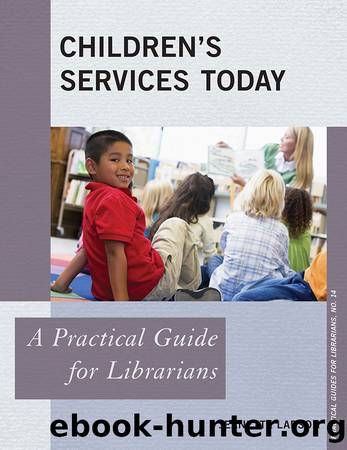
Author:Jeanette Larson [Larson, Jeanette]
Language: eng
Format: epub
Publisher: Rowman & Littlefield Publishers
Published: 2015-01-15T00:00:00+00:00
Chapter 5
Early Literacy Programs for Children and Families
In This Chapter
Understanding the value of early literacy programs
Discovering how the brain develops
Learning the features to include in storytime
Adding early literacy elements to storytimes
Exploring storytimes for different aged children
Storytime Programs
Public library storytimes are a cherished memory for many adults. In many libraries, storytimes are the highest profile part of the childrenâs librarianâs job. For many children, it is the first sustained interaction they have with a non-parental adult. There are many factors that go into planning storytime programs, and a number of anticipated outcomes are expected. In addition to sharing great books with children and helping them learn to behave as members of an audience, the public library storytime can set the stage for lifelong learning and library use, playing an important part in the education process.
Storytime is more than simply picking up some books and reading them to a group of children. The storytime presenter carefully selects books that are good to read to a group, books that not only are good stories but that also have excellent illustrations that reinforce the story and are large enough to be viewed by the group. The librarian is also modeling appropriate reading methods for parents and caregivers. Storytime includes activities that reinforce the stories told and encourage children to develop motor skills through crafts and interactive activities. The variety of stories selected reflects the diversity of the world around us, and stories encourage children to be curious about places and faces they may never see. Storytime also allows the librarian to be a performer and to encourage participation in creative dramatics, storytelling, and use of language.
School teachers and librarians also share books with children in a storytime setting, and many schools have established prekindergarten programs that also help establish a solid basis for learning. The major difference between storytime activities in a school setting and those in a public library primarily have to do with the audience. Classes have a limited number of students and some consistency in the class membership from week to week. Because the same children are together as a group on a regular basis, the teacher or librarian often knows the children quite well and interacts with the students more frequently and in different settings. While some school-based storytimes are offered for the pleasure of enjoying a good story, the particular books shared may be selected to support specific curriculum objectives and the development of specific skills required by state standards. While public library storytimes support the development of early literacy and learning skills, the emphasis is less on curriculum and more on enjoying literature.
Many public library storytimes must include children of different age levels and who are in different stages of child development. However, some libraries are able to hold programs designed specifically for a narrower target audience. While the basic structure for the program will be similar, different approaches work better to support the development of specific early literacy skills for different ages and levels of development.
Download
This site does not store any files on its server. We only index and link to content provided by other sites. Please contact the content providers to delete copyright contents if any and email us, we'll remove relevant links or contents immediately.
| Anthropology | Archaeology |
| Philosophy | Politics & Government |
| Social Sciences | Sociology |
| Women's Studies |
Cecilia; Or, Memoirs of an Heiress — Volume 1 by Fanny Burney(32538)
Cecilia; Or, Memoirs of an Heiress — Volume 2 by Fanny Burney(31935)
Cecilia; Or, Memoirs of an Heiress — Volume 3 by Fanny Burney(31925)
The Great Music City by Andrea Baker(31911)
We're Going to Need More Wine by Gabrielle Union(19032)
All the Missing Girls by Megan Miranda(15925)
Pimp by Iceberg Slim(14476)
Bombshells: Glamour Girls of a Lifetime by Sullivan Steve(14046)
For the Love of Europe by Rick Steves(13868)
Talking to Strangers by Malcolm Gladwell(13341)
Norse Mythology by Gaiman Neil(13332)
Fifty Shades Freed by E L James(13228)
Mindhunter: Inside the FBI's Elite Serial Crime Unit by John E. Douglas & Mark Olshaker(9313)
Crazy Rich Asians by Kevin Kwan(9271)
The Lost Art of Listening by Michael P. Nichols(7487)
Enlightenment Now: The Case for Reason, Science, Humanism, and Progress by Steven Pinker(7303)
The Four Agreements by Don Miguel Ruiz(6739)
Bad Blood by John Carreyrou(6609)
Weapons of Math Destruction by Cathy O'Neil(6260)
